
🎓 A Business Strategy Primer Part 1 - Getting The Audience Right
The Real Difference Between Having a 6, 7, 8, or 9 Figure Business

Getting your Audience Right
is whether you understand the phases of a funnel (value-ladder) and successfully monetize them. The main role of a business is to solve the problems of a customer in the form of “value”.
By understanding customers better, you are able to craft products that address more pain points of the customer. The better you are able to address the pain points, the bigger problem, and hence, the bigger value you provide to them
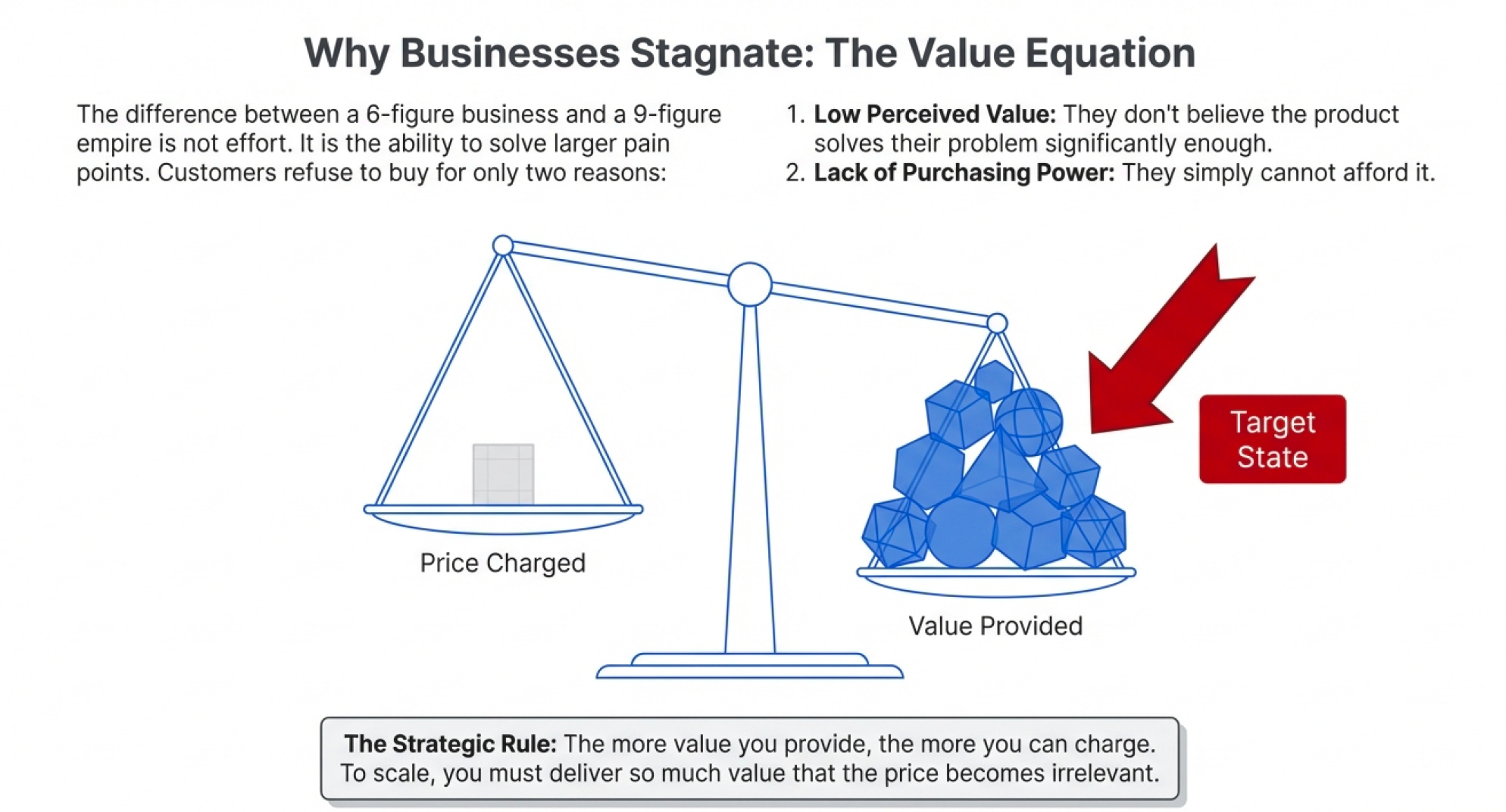
Remember, the more value you provide, the more you can charge. THEREFORE your customer is not getting you the revenue you want because of 2 reasons
👉 Reason 1: The customer thinks your product/ service does not provide enough value to them
👉 Reason 2: The customer does not have enough purchasing power to pay
Once you can get past these 2 hurdles, your imagination is your limit to how much your business can generate. Although the 2nd point is extremely important, it is pretty straightforward, so this guide will focus on the 1st point instead - How to get customers to think/ actually deliver so much value that they will pay you more for it
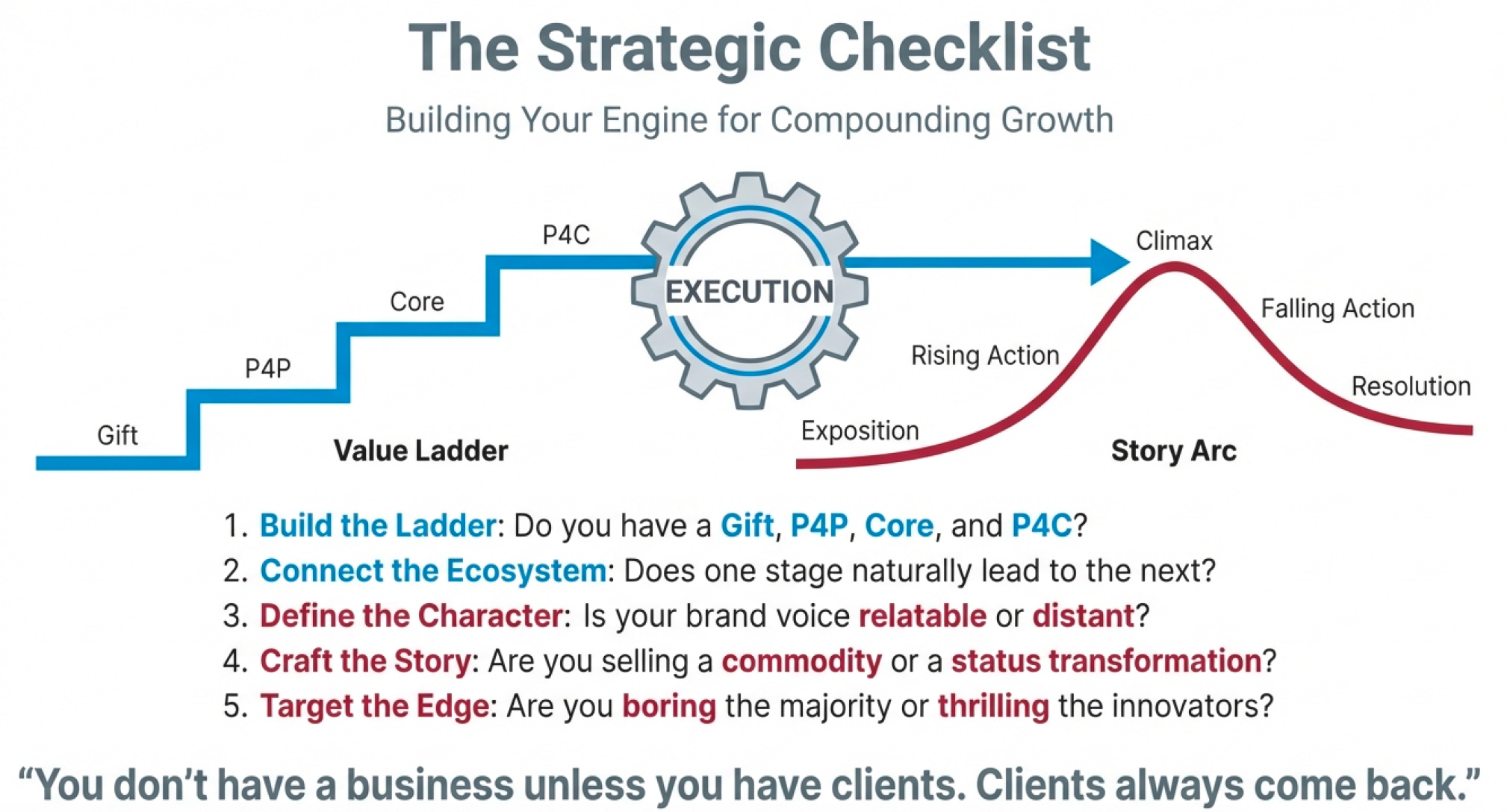
The Value Ladder
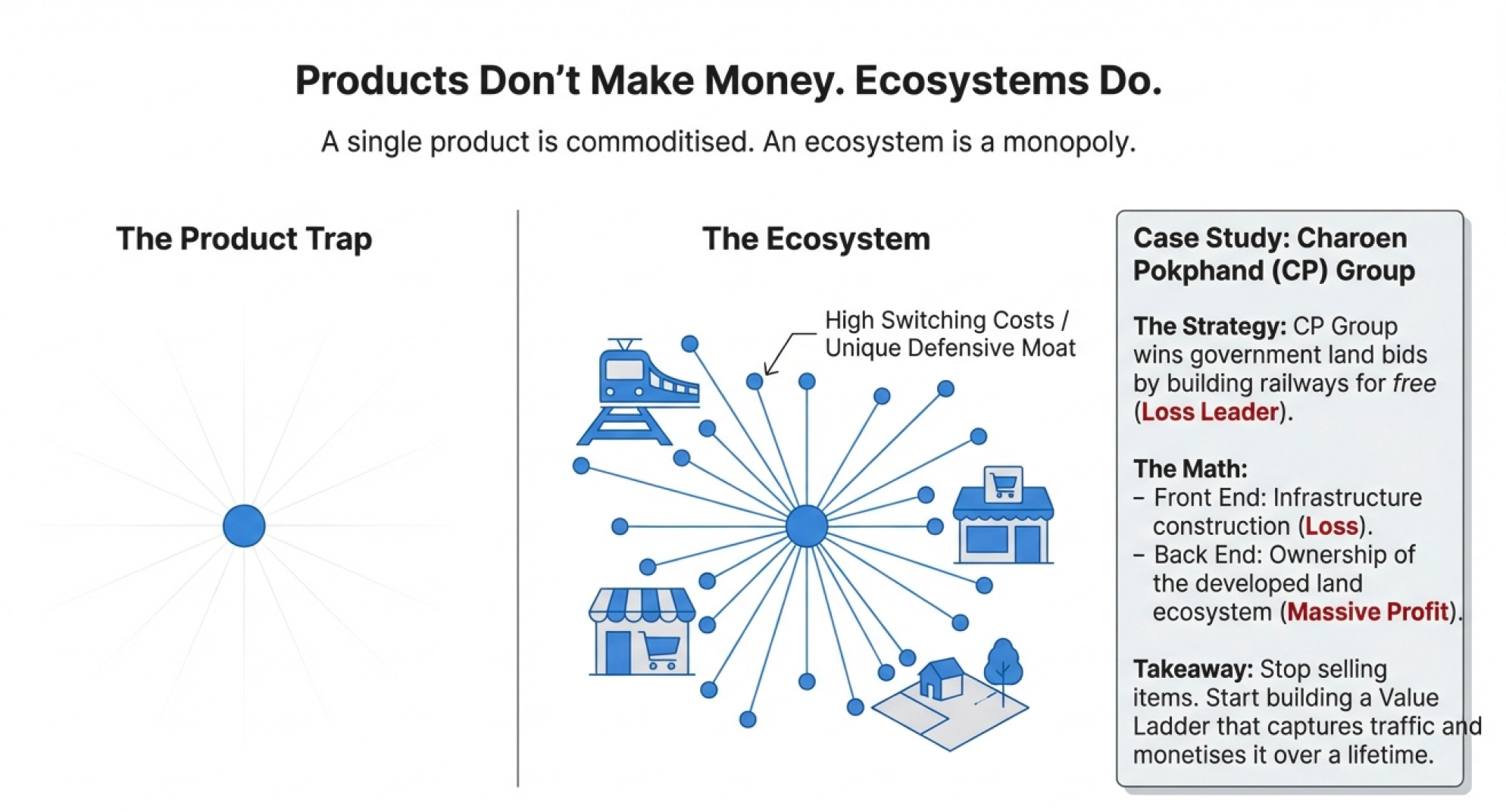
Alright.. back to the topic. In order to deliver huge amount of value that customers will pay you more for, you have to understand that “value” does not only come from your product. Products don’t make money, ecosystems do. Unique products (and services) are ones that are hard to replicate/ difficult to compete with, therefore, comprising of multiple elements. The more supplier, the more complex, the more personalized, the more pain-points resolves, the less likely it will be commoditised (e.g. the Porche 911 has over 2,500 suppliers)
A product is more than its physical/ service components e.g. what makes a certain product worth 4x its comparables with the same durability, function, and quality? - hint: it is the the pain-points in can solve for a specific customer, and these pain points usually related to a certain “status” (covered in later portions)
More often than not, a company only has 1 product or multiple products along the same level of what we call a “ladder” e.g. neck adjustment, back adjustment, hip adjustment.
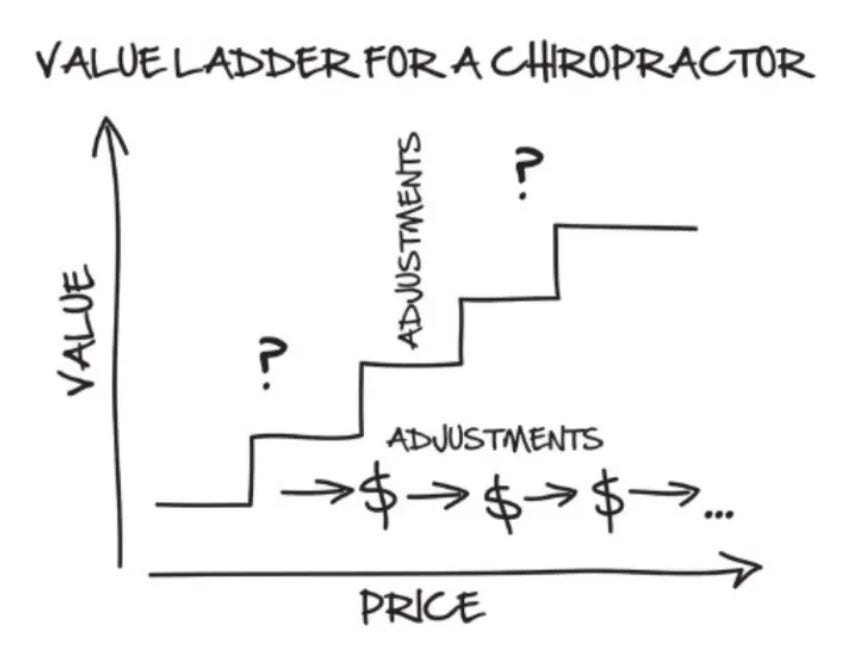
Let’s take a look at the example above. Value varies in ranges, and as human we pay less for what we value less, and more for what we value more. NOW you might then ask, why not just get the customer to pay for the highest value product? - will you?
Think about it, if a random company you do not know immediately asks you to purchase a 4 figure or 5 figure (heck maybe even a 6 figure) product/ service will you? No one in their right mind would! By offering a low value product/ service, you are lowering the barrier of entry the customer has to engage with you to build credibility and know WHO you are, TRUST you, and know your CAPABILTIES (or quality of product).
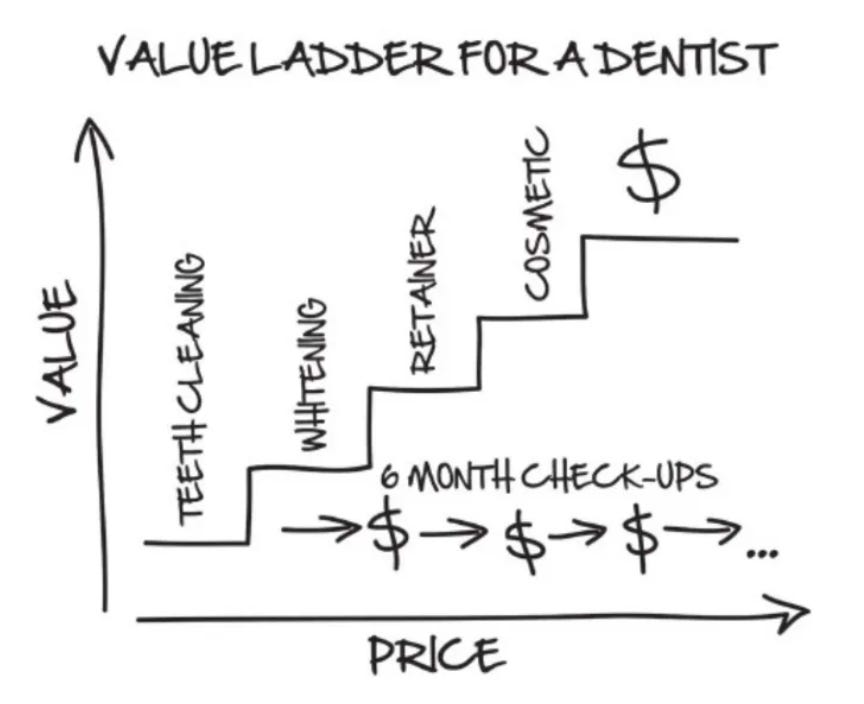
And another example with a dentist for you to get a better idea. Example of a value ladder (in sequence)
Free teeth cleaning
Whitening kit ($)
New retainers ($)
Cometics and so on...($)
More examples on how Chinese F&B businesses are taking over the scene in Singapore...

Mixue - $1 ice cream captures MASSIVE traffic and is a loss leader
Xiang Xiang - Free flow snacks and ice-cream also captures massive traffic along with their membership program
Hundred grains - $5 free flow buffet when average buffets costs in Singapore is $30+
Wonder why you still can operate when offering such ridiculous value? - that’s because you only see the front-end of the funnel. Guess what, we haven’t even talked about Haidilao. Now you know why Chinese businesses are taking over?
Now, you might be thinking that just because the examples uses B2C companies, that this model is not applicable elsewhere. Here’s a interesting one:
Charoen Pokphand (CP) Group (the richest Thailand family business) wins massive land bids from the government BECAUSE they offer to build out infrastructure like railways in the developed area for FREE - who doesn’t love free right? On the front-end, it seems like they are losing a huge amount of money but study the whole value-ladder and their LTGP:CAC (Life Time Gross Profit relative to Customer Acquisition Cost). You will realize they have gotten a MASSIVE steal - Isn’t this amazing?
And The Best Part
There is nothing stopping you to add more products/ services at the back-end of the ladder. Therefore, your imagination is your limit to how much your business can generate. You will just need to test > get data/ find what Peter Thiel deems as “secrets” > change the test > repeat until it works
A chiropractor can add a Free Massage (on the front end) to detect problems and upsell adjustments and a Wellness program (on the back-end).
A Value Ladder also includes a “Continuity” portion (software, membership, coaching, subcription.etc)
e.g. a follow-up 6 months later so the dentist can provide a free teeth cleaning to value-add first so he can upsell you more
e.g. click funnels’ website subscription
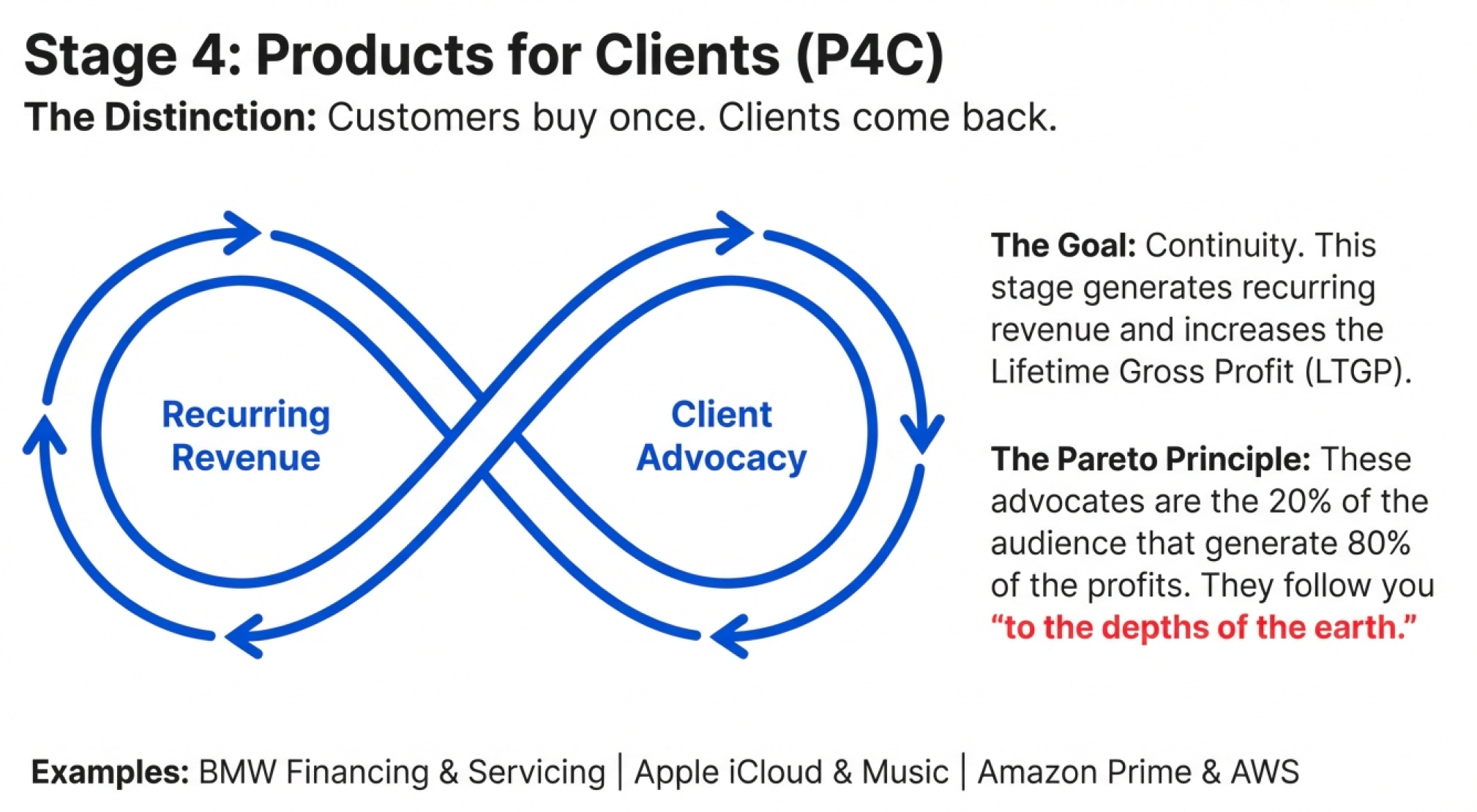
You don’t have a business unless you have clients instead of customers. Customers only buy once. Clients always come back and pay a recurring. You know when they are going to come back EXACTLY. And you know their deepest pains. Because of this, they follow you to the depths of earth and are willing to pay more. They are advocates and are the “20%” that generates “80%” of your profits.
Just look at Amazon. Their largest profit generators aren’t consumers like you who buy from their site, they are 👇

Now that we’ve got the framework right, let’s dive more into each specific stage of the ladder (from now on we will refer “ladder” as “funnel”).
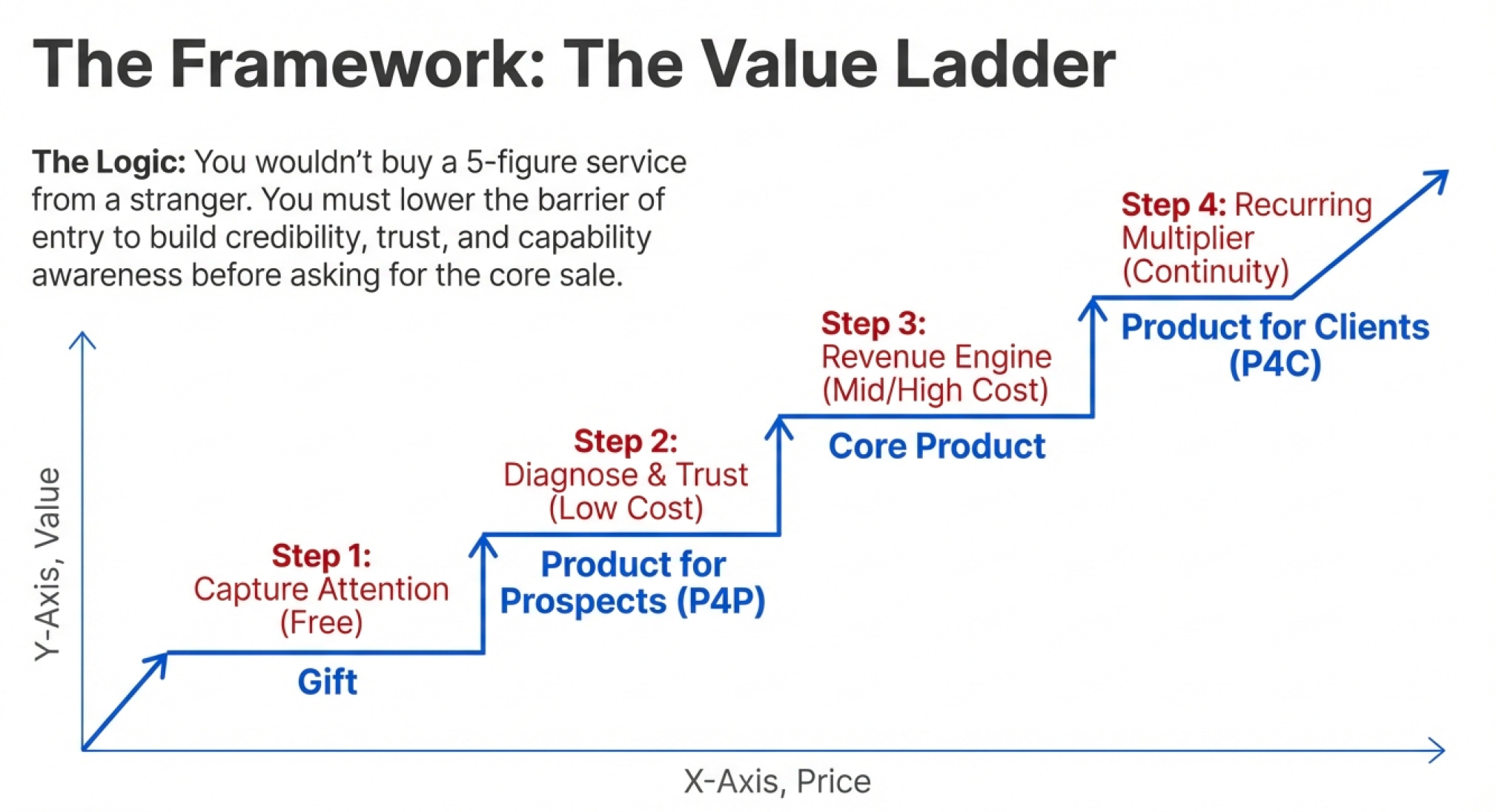
Sections of a Value Ladder
Now that we understand the concept of a value ladder, let’s take a look at the possible type/ tranches of Assets we can create in a value ladder (in order of front-end to back-end).
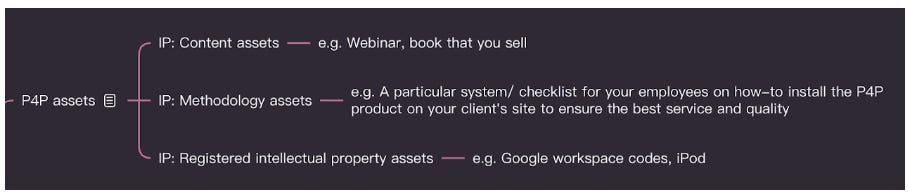
Also, all product assets can be further sub-categorised as IP assets (content, methodology, registered IP) as well as we shall we below.
Note: Content and methodology assets can be converted to registered IP assets. But more often than not, softwares, patents, and device innovations are immediately placed into this category
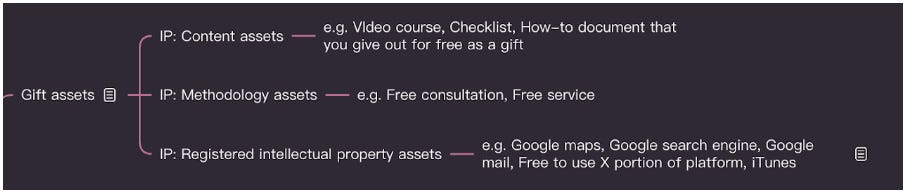
1️⃣ Gifts
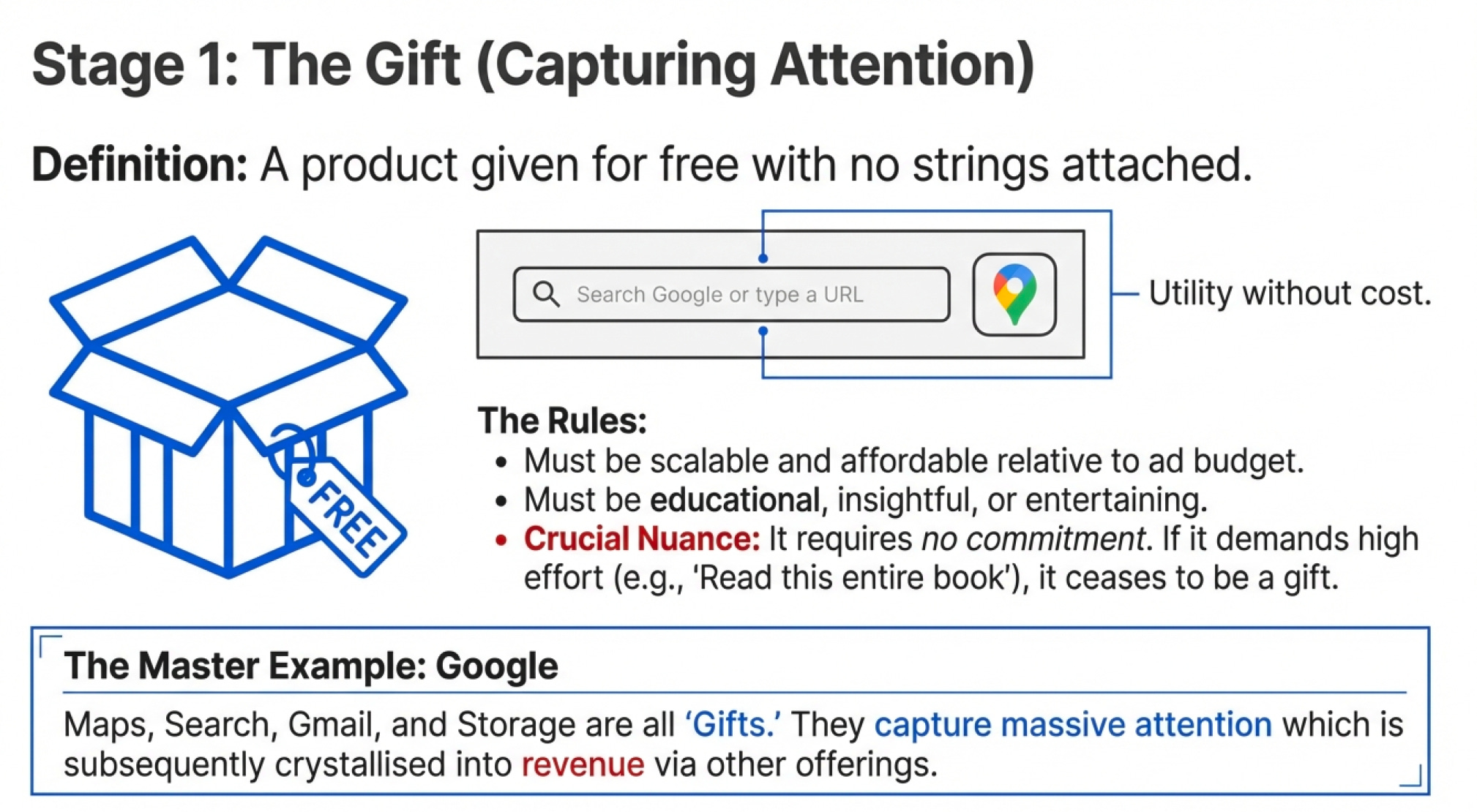
A product given for free with no strings attached, primarily to capture attention. They should be scalable and affordable relative to advertising budget, without giving too much thought.
Gifts need to be educational, insightful, or entertaining
Gifts need to highlight the problems your business can solve, illuminate your value and build a emotional connection
Gift require no commitment. When expectations are attached and if an exchange (either requiring money or high effort e.g. read a book or watch a 1 hour video) is implied, it ceases to be a gift
Google is the ultimate gift giver e.g. Google map, search+chrome, email, storage, video, and research. These products capture attention that Google subsequently crystalizes by other offerings
2️⃣ Products for Prospects (P4P)
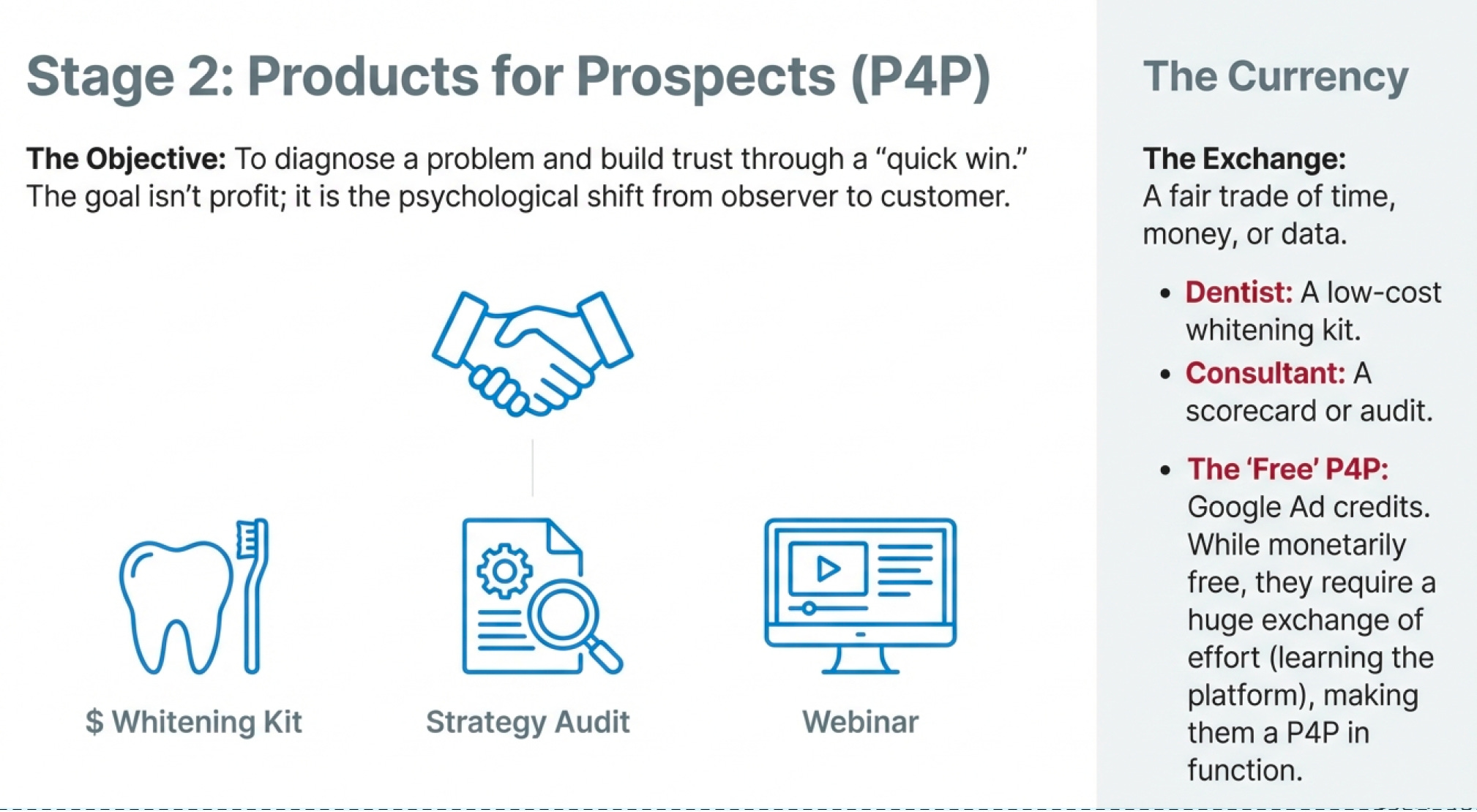
P4P is the first purchase a customer makes after receiving a gift. It helps to diagnose a problem. The objective of this purchase is to build trust by creating quick wins for a fair exchange of commitment time, money, or data. e.g. scorecard, webinar, books, strategy-session meetings

3️⃣ Core product
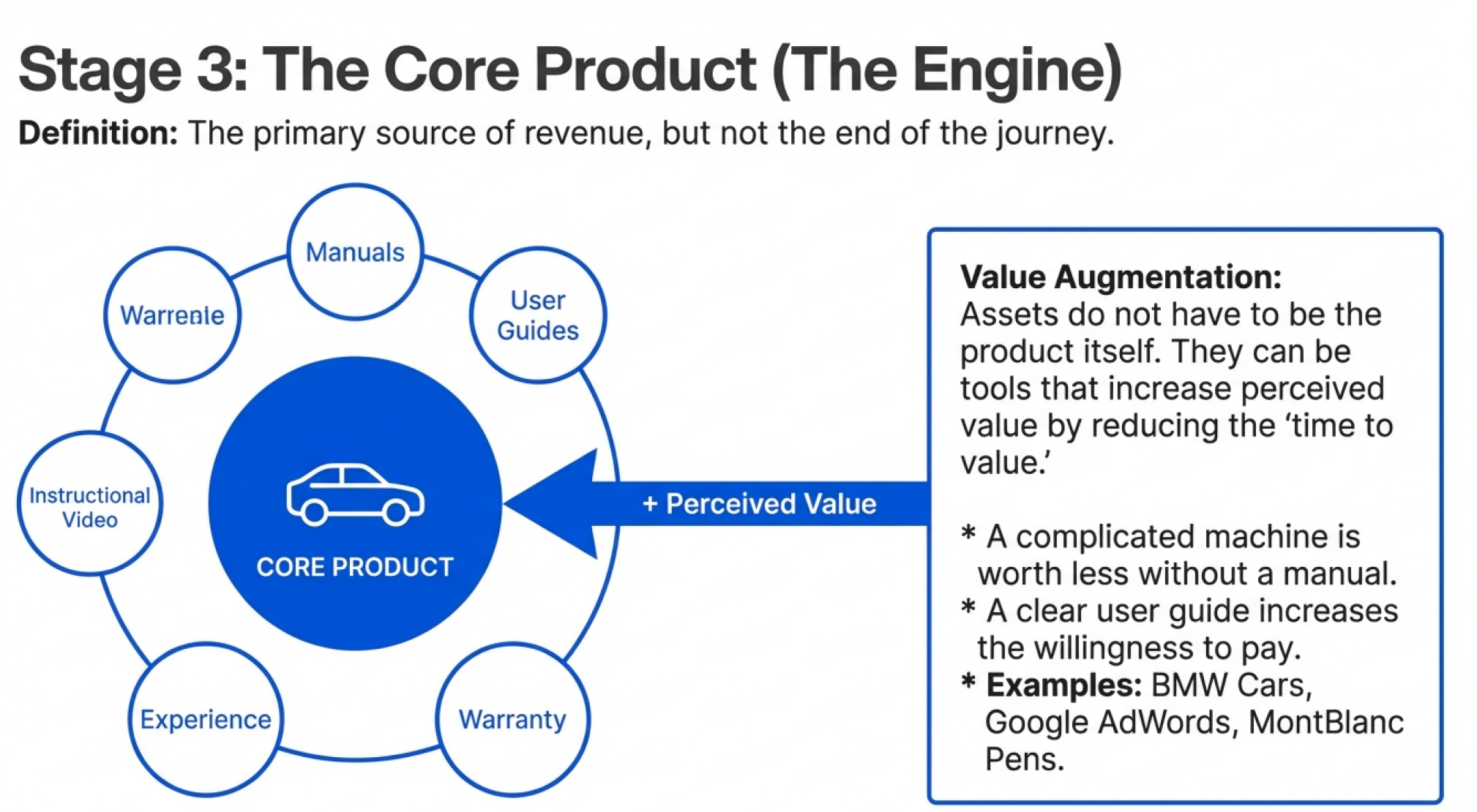
The main source of revenue. e.g. Cars for BMW, AdWords for Google, Pens for MontBlanc
Assets do not have to be the product itself but can be augmenting the product, increasing its perceived value. Think about it, will you buy a complicated product without a instruction video/ manual? Would you waste your own time trying to figure out how that works? And if there is a guide, how much will you pay for it?
Experience is also a value that customers pay for - think LVMH, think concerts, Movie, Events
A Free P4P: Note that when you create a google workspace and business mail, google always prompts you with free ad credit to use. That is a Free P4P which does not require you to pay but require you to put in huge amount of effort (an “exchange”) to learn how to set-up and run the ads (this is low cost)
Subsequently, the prospect is then upgraded to fully paying for Google ads and the amount they pay scales up.

4️⃣ Products for Clients (P4C)
Extensions that take customers even further in their journey. These customers tend to be advocates. It is usually recurring (the continuity program) that provides value over time
e.g. for BMW, their core products are cars but they extend it with financing, insurance, and servicing/ for Apply, their core products are devices but they extend it with media, storage, software, and music subscription that are recurring
The product Ecosystem
A single product rarely makes money, but a product ecosystem makes the most money. Most business often have 1 core-product and an expensive one at that. This isn’t how great businesses operate, they have a range of free, low-cost, and core products that all serve a unique purpose.
This works because it significantly increases LTGP:CAC (LTGP significantly increase due to recurring high ticket P4C whilst CAC significantly reduce due to Gifts). LTGP:CAC will be explained later
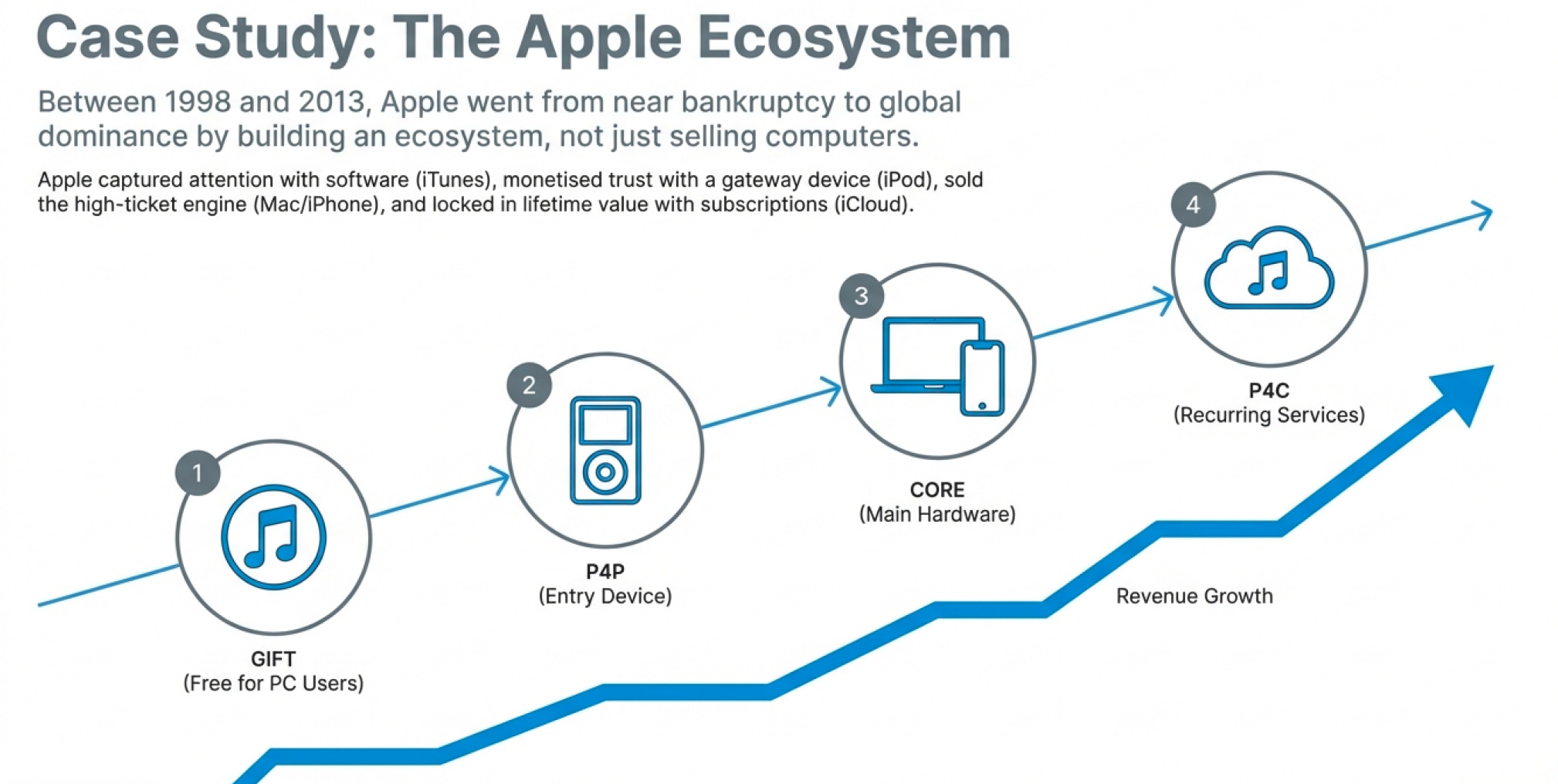
Between 1998 and 2013 Apple went from near bankruptcy to the most successful company in the world. The success is linked to the ecosystem that Steve Jobs created - he gave away iTunes as a gift to PC users (Gifts), the iPods became the ideal first purchase (P4P), the core business was computers and devices, and they profitted majorly from recurring iCloud content and media sales.
The Longer You Can Keep Customers Around You, and The More Value You Provide, The More Likely They Will Buy From You
The Not So Secret Formula
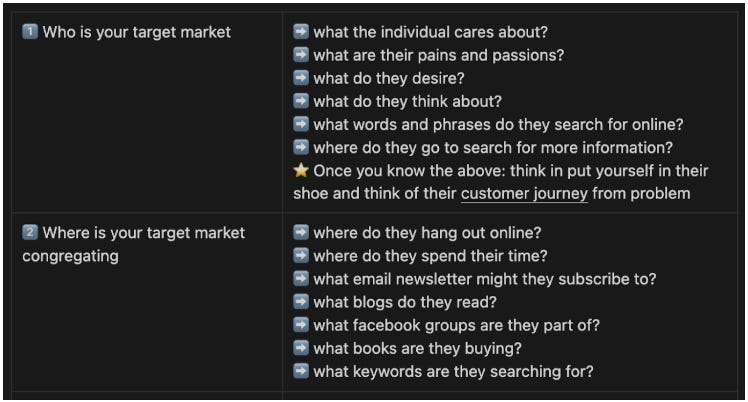
Our next steps would be to create irresistable products. But in order to do so, we would first need to understand our audience better (remember more pain points = more value to provide = more $$$). So let’s take a look at how to idenitfy the right audience and create branding at the same time...
Create an Attractive Character
It is crucial to build out an Attractive Character based on your dream customer’s interest and demographic. Your customers should be able to relate to your attractive character
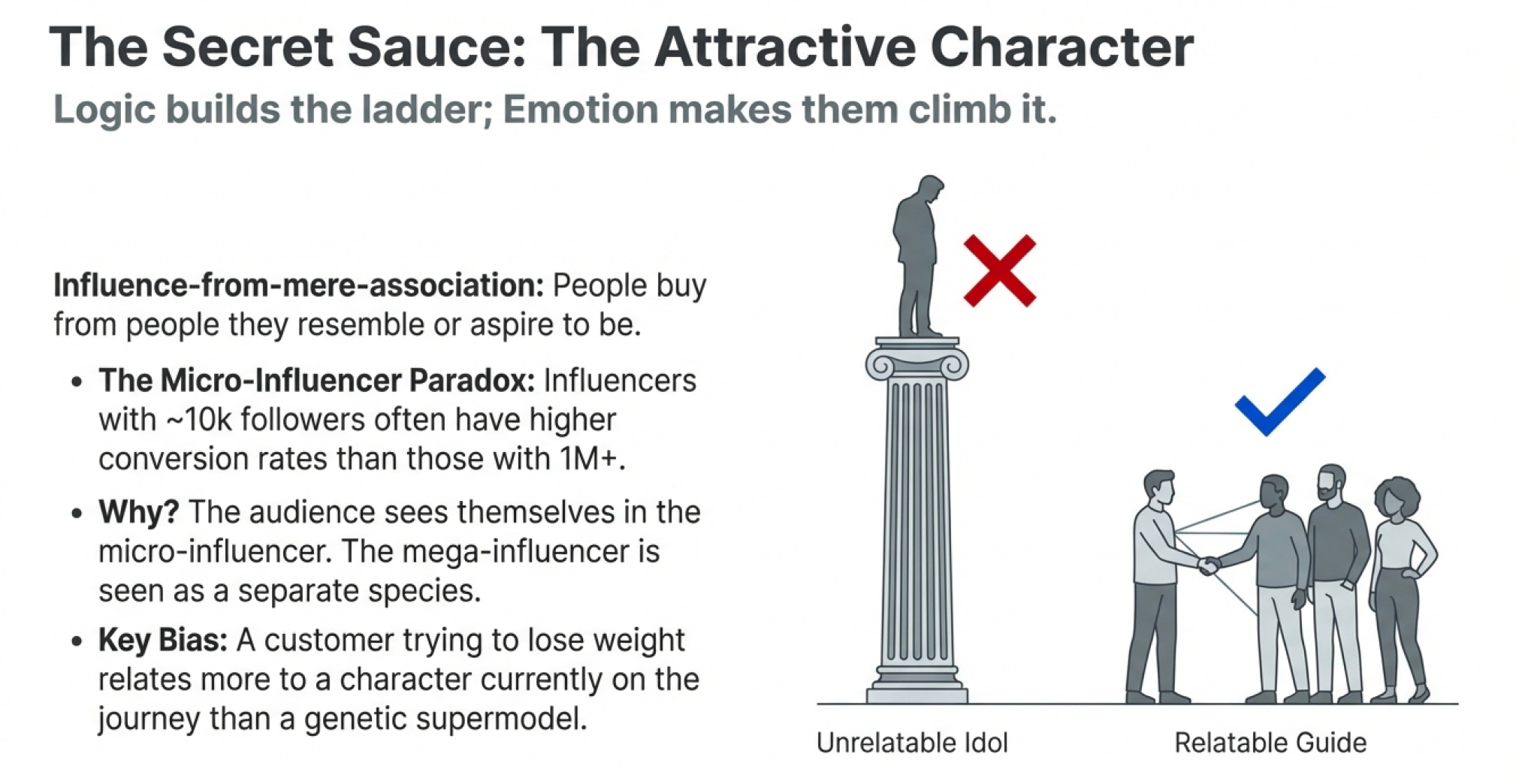
You need an Attractive Character because it is the best way to tell a story to justify a price (this is why testimonials work). The essence of a story is created by a brand. And a brand is created from influence-from-mere-association tendency. This is why when you sell a product, you tend to see micro-influencers (about 10k followers) have higher conversion rate than mega-influencers (about 1 million followers) - people relate to them more. On the other hand, mega influencers are put on a pedastal and worshipped as if they are a whole other seperate being, hence, consumers can’t relate. The same psychological behaviour applies in any scenario
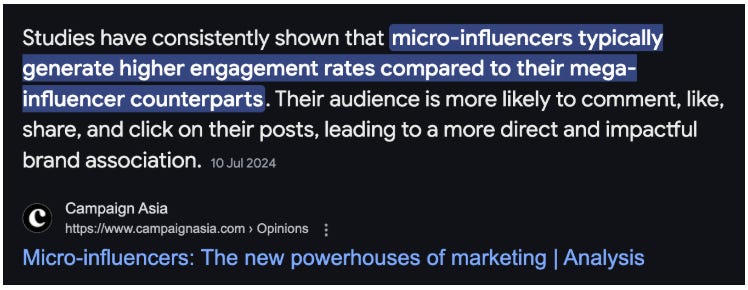
Note: people like who they most resemble (liking loving tendency cognitive bias). e.g. a fat guy will “like” a fat guy trying to lose weight because he can always relate to him
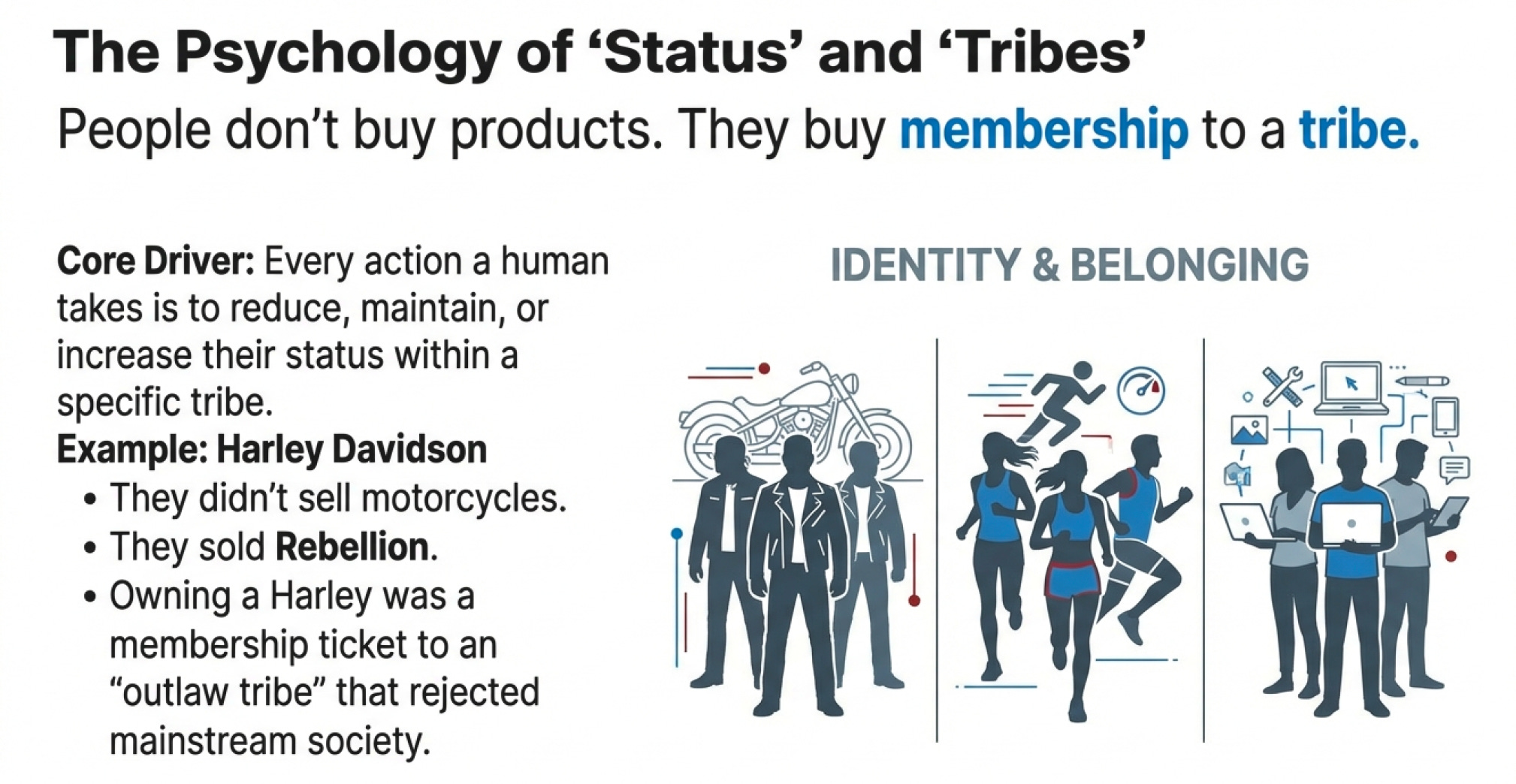
A brand is built when you have accomplished/ help your customers accomplish “X” (”X” is associated to elements of the status your target audience seeks). In society the main driving factor for ANYTHING is status. If you consciously take note of your actions, you are always executing a certain action because that act/ that behaviour/ way of thinking will move (reduce, maintain, or increase) your “status” of [something]. Society is built on status. AND Status is always linked to a perception of a “tribe” that you resonate with e.g. you might be helping a grandma carry her groceries because you feel that it is the right thing to do. This “right thing” is there in your mind because that is the perception of your “tribe” - this is the core of a brand. Watch this 👇 and read the comments 🙌
Harley Davidson didn’t sell motorcycles—it sold rebellion. Owning a Harley meant joining an outlaw tribe (Hell’s Angels, veterans, biker gangs) that rejected mainstream society. Their “X” was authentic defiance, a status symbol for those who wanted to be seen as untamed. And hands down, one of the best brands
The Watch Company That Isn’t a 100 Years Old
Creating an expensive men’s watch is simple – there are two main ingredients. First, locate your company in Switzerland. Second, begin making watches at least 100 years ago.
If you have those two things, you’ll be well on your way to charging a small fortune for a timepiece that every man aspires to own. Rolex, Omega, Breitling, IWC, Jaeger-LeCoultre, Zenith, Tag Heuer, and Longines all follow this formula successfully.
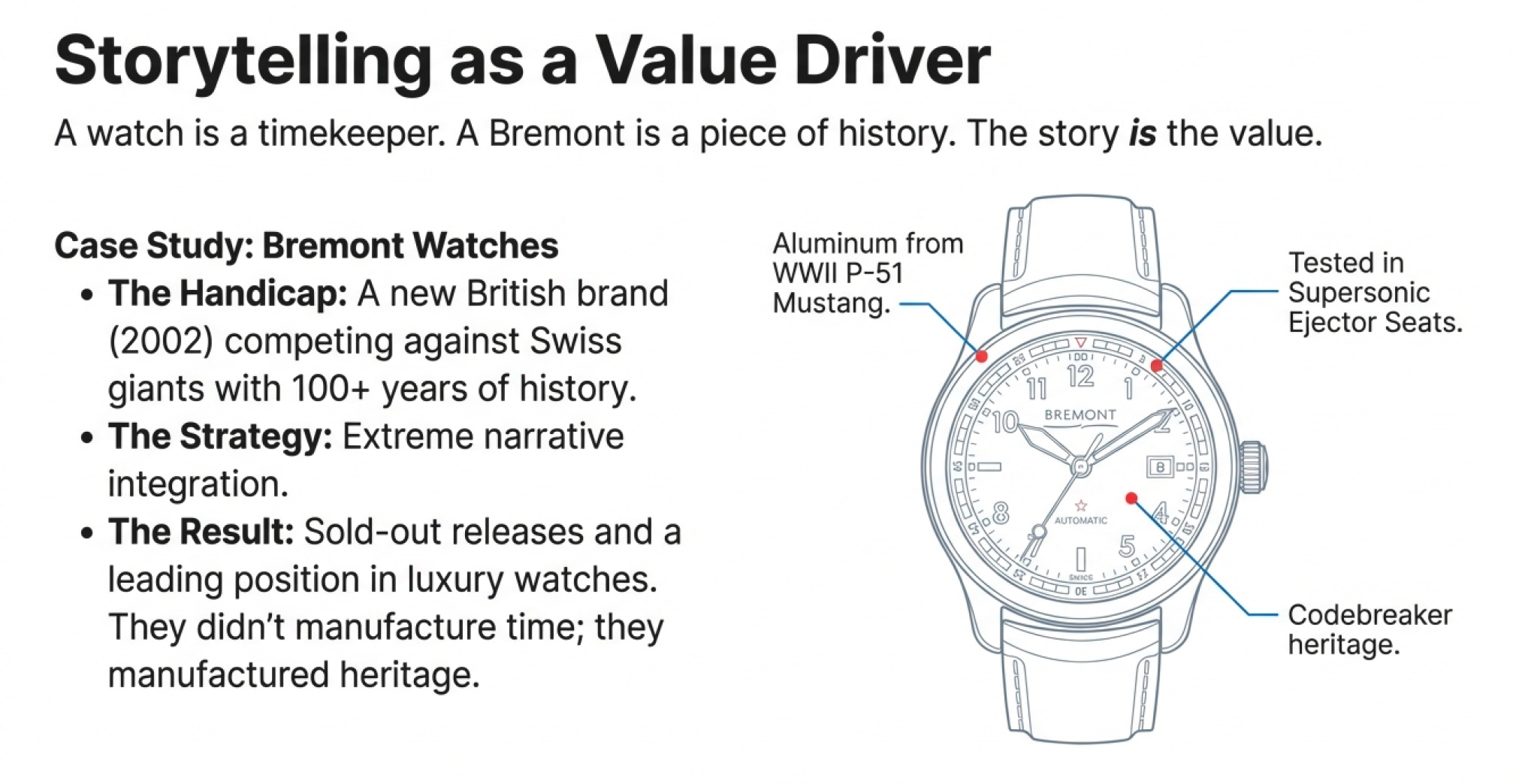
Then there’s Bremont, a British company founded as recently as 2002 and who are unable to keep up with the demand for their limited range of chronographs. They aren’t Swiss, they only recently celebrated their 10th birthday – yet they have taken a leading position in the fiercely competitive luxury watch business.
Bremont is remarkable at telling stories and it all begins with the founding of the company, a story about two brothers who share the love of flying with their charismatic father. Then the tragic story of losing their dad in a light aircraft accident, which led to the story of the impassioned decision to fulfil an ambition and create a company making pilots’ watches. There’s a delightful story about the way the company got its name after the brothers performed an unplanned landing on a flying adventure.
Immediately you feel a sense of connection; when you hear their story, you almost feel part of it.
Each watch these brothers make has a story too. There’s the range that was inspired by a B-2 stealth bomber pilot who wanted a completely black watch to match his completely black jet. There’s the story of how they are the only company to test their watches for supersonic ejector seat deployment from a fighter plane. There’s the story about how every pilot who ejects (and survives) gets a special red bezel fitted to their watch. There are stories about adventurers who take Bremont watches to the Arctic, to the depths of the oceans, to the deserts, to the upper atmosphere and deep into remote jungles.
They have watches that you can only buy if you are “pre-authorized military personnel”. There’s a timepiece that’s hand painted by Ronnie Wood of the Rolling Stones. A watch created for Scotland Yard detectives and another for a Hollywood movie about the Secret Service. There’s the story they tell about how each glass face is coated with 9 layers of anti-scratch protectant. How they have a special way of making their steel stronger than . . . well, steel.
Before this company releases a watch they first start telling its story. There’s a watch that contains parts from a significant WWII plane. There’s a watch that contains parts from Bletchley Park’s code-breaking equipment and the watch that will raise money to preserve an historical sight.
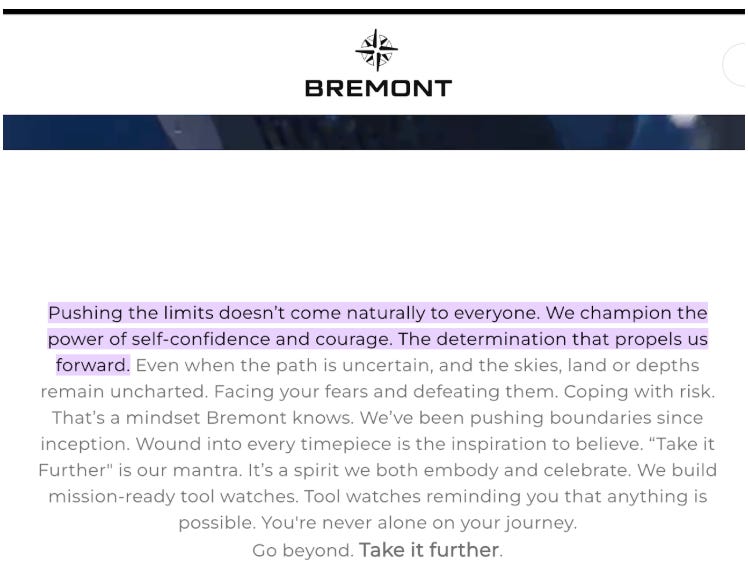
As a result of telling these stories, many of the watches are sold out on the week they are released. If you’ve noticed every story told and every campaign launched is helping their dream customer to reach the status of “toughness, power, courage, facing fears, and braving frontiers”.
Now let’s learn how to create a great story...
Tip: Leverage on The Power of Congregation
Not sure where your congregations are? Just go Google/ Facebook and type in [your target audience keyword] + “forum” or “group”
The Framework of a Great Story
As you have seen in almost all great funnels and brand, there is always a story. Great companies succeed because of the stories they create. This is why
According to a 2022 report by Headstream, 79% of consumers prefer brands that tell stories.
Story-driven ads have been shown to generate up to 22 times more recall than ads based on facts alone (Stanford Graduate School of Business).
According to the Nielsen Total Audience Report (2023), the average American spends over 11 hours per day interacting with media (TV, streaming, social media, etc.), much of which is narrative-driven
Cognitive psychologists like Jerome Bruner have estimated that “narrative accounts for 60% of all human communication.”
The fact is that, an average human spend most of his/ her time either taking in a story or living a story of their own.
Elements of a Good Story
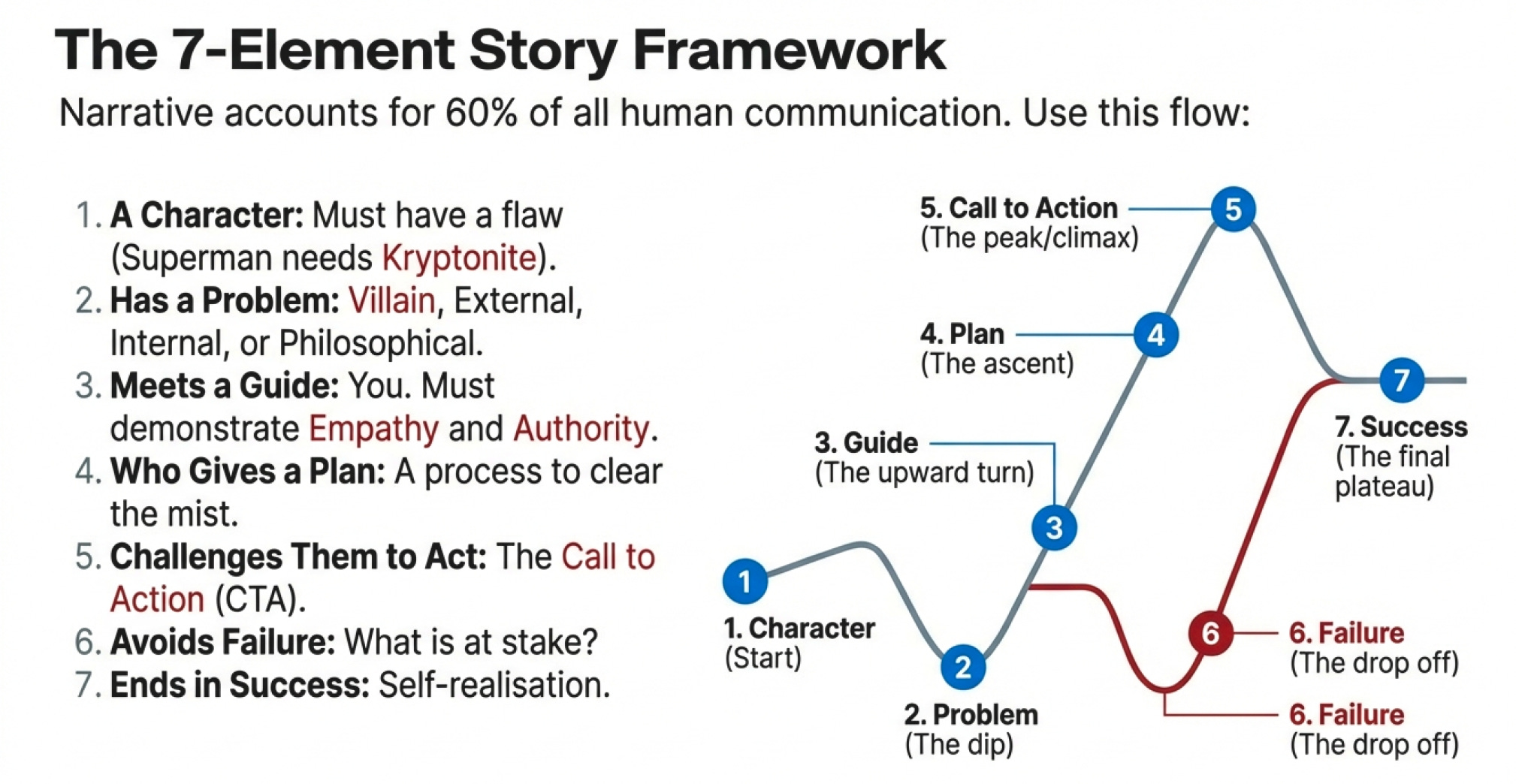
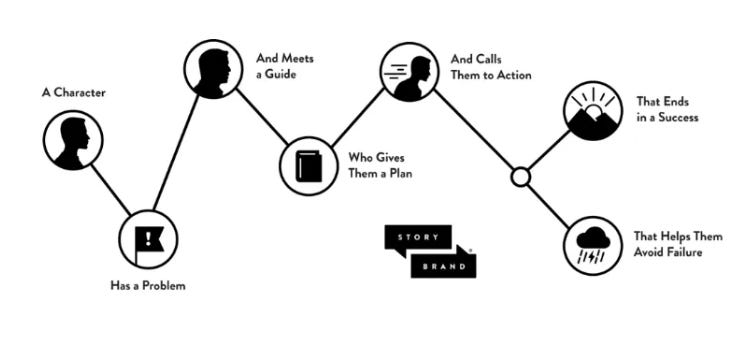
A good story do not consist of all elements but here’s a guide (best implemented with visuals 🔥+ always ensure that your message is short and sweet 🚀):
A Character
What is their background, and most importantly what is their flaw or weakness? Superman wouldn’t be interesting if he didn’t have kryptonite as his weakness, and Batman wouldn’t be adored by millions of teenage boys if he had superpowers. Who is the “Hero” in your story?
That has a Problem
The Hero usually faces many problems but they mostly come in 3 forms:
The villain/ situation which subsequently causes e.g. the bully in karate kid
A external problem which is tangible and hence results in... e.g. the hero getting beaten down and looked down upon
An Internal problem .e.g the hero feeling inferior and have low self-esteem which then leads to another external problem which is failing exams.etc
It would be a HUGE bonus if your story also addresses a philosophical problem (why does this matter to the world?). e.g. how the Matrix movie portrayed the story with the concept and importance of “free-will” in this world.
Meets a Guide
Usually the business (you). The guide has both
Empathy which builds trust, and (e.g. showing that you are listening to what the customer is saying by quoting their words and worst fears)
Authority which builds respect (e.g. customer’s testimonials, awards.etc)
This is important because a Harvard study, highlights that trust and respect are crucial foundations for people to listen to a business.. The guide (your business) will also give them a Plan:
Agreement plan (addresses fears like guarantees) and/ or
Process plan (includes steps before/ after use, preferably 3-steps)
This plan will help them to feel confident and clear the mists of “what’s next?”. The plan includes the “thing” (lead magnet) in the climax section below👇 And, the main objective of the plan will be to help them to avoid Failure:
What is at stake? what will they lose if they don’t buy your products?*
Guide/ environment/ outside force will .....
Challenge the character to take action
Direct buy CTA, or
Transitional CTA that builds up and eventually leads to purchase (usually a lead-magnet which is covered in next section)
Stress-influence tendency & Newton’s Law of intertia: humans act when they face stress significant enough to move them. This can be a push (e.g. fear) or pull (reward)
And your story must always finish with a ....
Climax
How the story ends in Success? How will it look like?
This will include the “things” that will result in the success (solves all 3 problems above - villain, internal, external):
Ending type 1 - Win some sort of power/ position e.g. access to club or product
Ending type 2 - Be unified with somebody or something that makes them whole e.g. product reduces anxiety, time, or workload
Ending type 3 - Experience some kind of self-realization that makes them whole e.g. product give inspiration, transcendence, acceptance
In summary, this is how it looks like, how your how business system/ funnel should look like:
Bridging The Chasm
What’s the point of advertising a (mass market) product that doesn’t appeal to everyone? By following this this guided logic, marketers ensure that their products have the minimum possible chance of success.
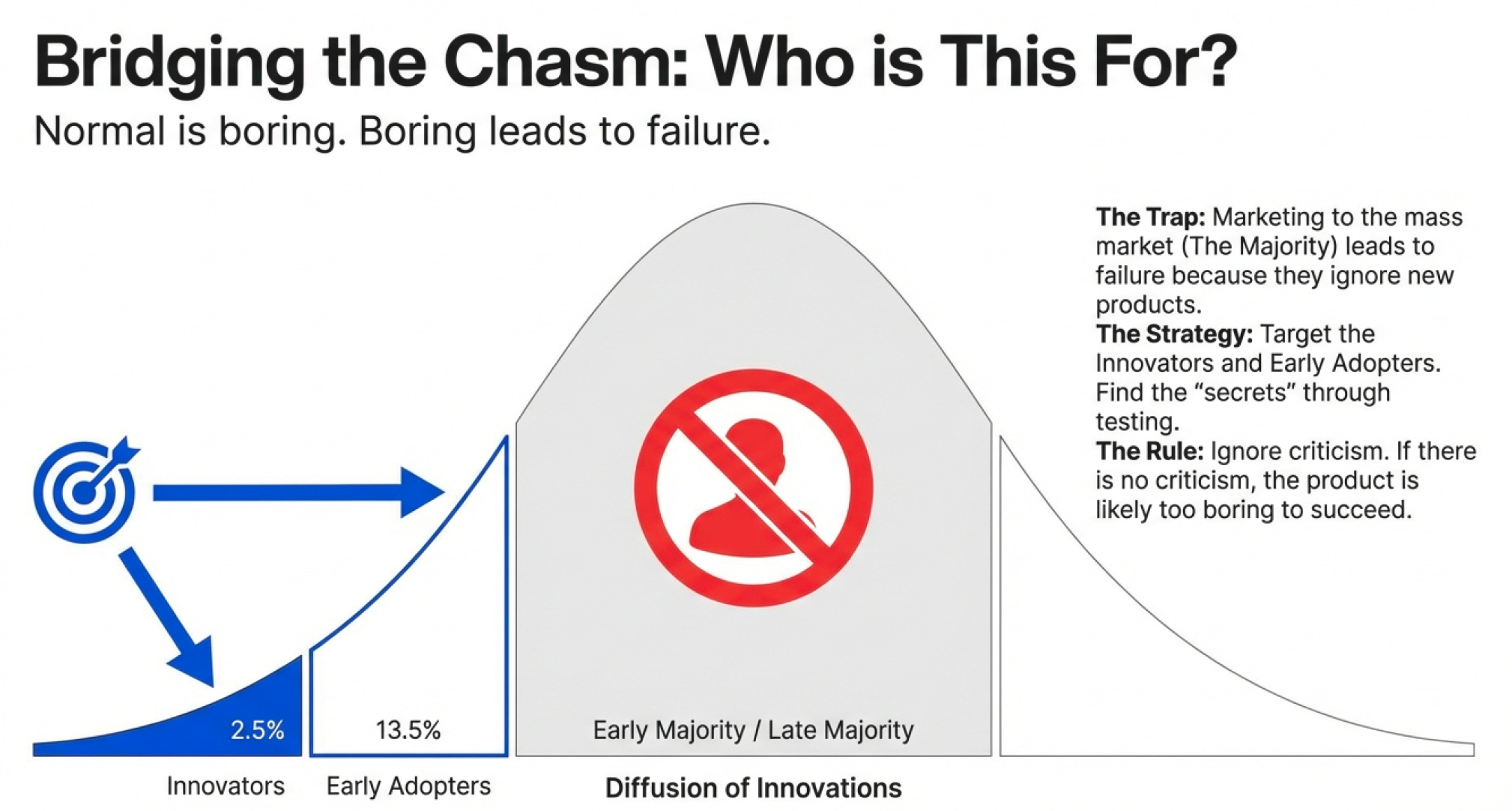
Having no criticism to your product is normal → Normal is boring → Boring always leads to failure
Remember, there are only two kinds of audiences
1. The highly coveted innovators and adopters who will be bored by this mass-marketed product and decide to ignore (ur target ✅)
2. The early and late majority who are unlikely to listen to an ad for any new product, and will unlikely buy it if they do (you want to ignore them)
References
Hormozi, Alex. $100M Offers: How To Make Offers So Good People Feel Stupid Saying No. Acquisition.com Publishing, 2021
Hormozi, Alex. $100M Leads. Acquisition.com Publishing, 2023. ASIN: B0CFDR3TYV.
Brunson, Russell. DotCom Secrets: The Underground Playbook for Growing Your Company Online. Morgan James Publishing, 2015. ISBN: 9781630474775.
Koch, Charles G. Good Profit: How Creating Value for Others Built One of the World’s Most Successful Companies. Crown Business, 2015. ISBN: 9780804189323.
Sullivan, Dan, and Hardy, Benjamin. The Laws of Lifetime Growth: Always Make Your Future Bigger Than Your Past. Berrett-Koehler Publishers, 2006.
Munger, Charles T., edited by Peter D. Kaufman. Poor Charlie’s Almanack: The Wit and Wisdom of Charles T. Munger. Donning Company Publishers, 2005.
Priestley, Daniel. 24 Assets: Create a Digital, Scalable, Valuable and Fun Business That Will Thrive in a Fast Changing World. Rethink Press, 2016.
Collins, Jim. Good to Great: Why Some Companies Make the Leap... and Others Don’t. HarperBusiness, 2001.
Godin, Seth. Purple Cow: Transform Your Business by Being Remarkable. Portfolio, 2003.
Godin, Seth. This is Marketing: You Can’t Be Seen Until You Learn to See. Portfolio, 2018.
Suby, Sabri. Sell Like Crazy: How to Get As Many Clients, Customers and Sales As You Can Possibly Handle. King Kong, 2019.
Priestley, Daniel. Oversubscribed: How to Get People Lining Up to Do Business with You. Capstone, 2015.
Greenwald, Bruce, and Judd Kahn. Competition Demystified: A Radically Simplified Approach to Business Strategy. Portfolio, 2005.
Slow Ventures. “Franchising Thesis - Why Venture Should Care About Franchises.” DocSend, accessed May 7, 2025. https://docsend.com/view/68uxgs3jawk2szrv